
If the design, placement or execution of a tattoo no longer feels right, it’s natural to wonder how to improve a poorly designed tattoo without making it busier or harder to read. The right direction depends on the ink already in your skin, what you want to change and what you hope to keep.
A thoughtful redesign starts with an honest assessment, not a one-size-fits-all fix. Some tattoos may benefit from refined lines or shading; others can be incorporated into a larger composition, while a cover-up may suit a different goal. Because new ink interacts with existing pigment, the artist needs to consider how each option may affect clarity, contrast and flow.
This guide explains what an artist assesses, how refining, adding to and redesigning existing elements compare, and how a digital mock-up can help you discuss a considered direction. At Sash Tattoo in Beverly Hills, Sydney, a collaborative consultation gives you space to explain what feels wrong, explore custom styles such as realism or Japanese tattooing, and plan around your existing ink.
Key Takeaways
- To understand how to improve a poorly designed tattoo, pinpoint what concerns you, from scale and placement to line work, shading or personal meaning.
- An artist assesses the existing shape, contrast, line weight, negative space and surrounding skin before discussing a design direction.
- Refining, adding imagery or redesigning the composition each involves different possibilities and trade-offs. The appearance and condition of your existing ink help guide the choice.
- Bring references and clear priorities to your consultation, then use a digital mock-up to discuss composition and placement before tattooing.
- At Sash Tattoo in Beverly Hills, Sydney, a collaborative consultation draws on Sash Trajkovski’s more than 33 years of experience to shape a bespoke approach to your tattoo.
How to improve a poorly designed tattoo starts with identifying what feels wrong
Feeling dissatisfied with a tattoo doesn’t mean you need to rush into changing it. Start by describing what you notice and what you would like to feel different. Is the design too large for the area? Does its placement interrupt the body’s natural lines? Do the proportions, line work or shading make the image difficult to read? Naming the concern gives an artist a clearer starting point than saying only that the tattoo feels wrong.
Meaning matters, too. A design may be well executed but no longer reflect your taste, identity or circumstances. That differs from a composition that feels unbalanced or details that have lost clarity. Tattoos can also change in appearance as skin and ink age. Compare what you see now with your original reference or memory, but don’t treat a photograph as a diagnosis. Lighting, camera angle and image quality can change how lines and shading appear. An in-person assessment lets an artist see the tattoo on your skin and consider how it sits on your body.
A design concern is about how a tattoo looks and reads; a healing or aftercare concern is about how the skin is recovering. If you’re unsure which applies, explain what you’re noticing and when it began. A design discussion should account for your priorities and the existing work, rather than assuming every change in appearance calls for a redesign.
Is the issue the design, the placement or the way it has aged?
Ask yourself what draws your attention first, then why. Perhaps the image looks crowded from a distance, sits awkwardly with nearby tattoos, or has a line or shaded area that stands out. You might instead find that your preferences have changed, even though the tattoo still reads clearly. These differences help separate composition and readability from a shift in personal taste. Before recommending a redesign, an artist needs to assess the tattoo in person, including its scale, position and visible detail.
What to gather before asking about a tattoo redesign
Prepare clear photographs in natural light, taken from a comfortable distance and without filters. Bring the original reference or design if you still have it. Make a short note of what you want to keep, change or avoid, such as a meaningful symbol you’d like preserved or extra detail you don’t want added. Be candid about the tattoo’s history, including previous changes and what you know about its age. This gives the artist useful context, but it cannot guarantee a particular result.
Personal context can also guide the conversation: tattooing has a long history and varied cultural significance, as the general overview of tattoos explains. You don’t need to arrive with a complete redesign. A clear account of what feels off, what still matters and what you hope to change is enough to begin a thoughtful consultation about how to improve a poorly designed tattoo.
How an artist assesses an existing tattoo before proposing changes
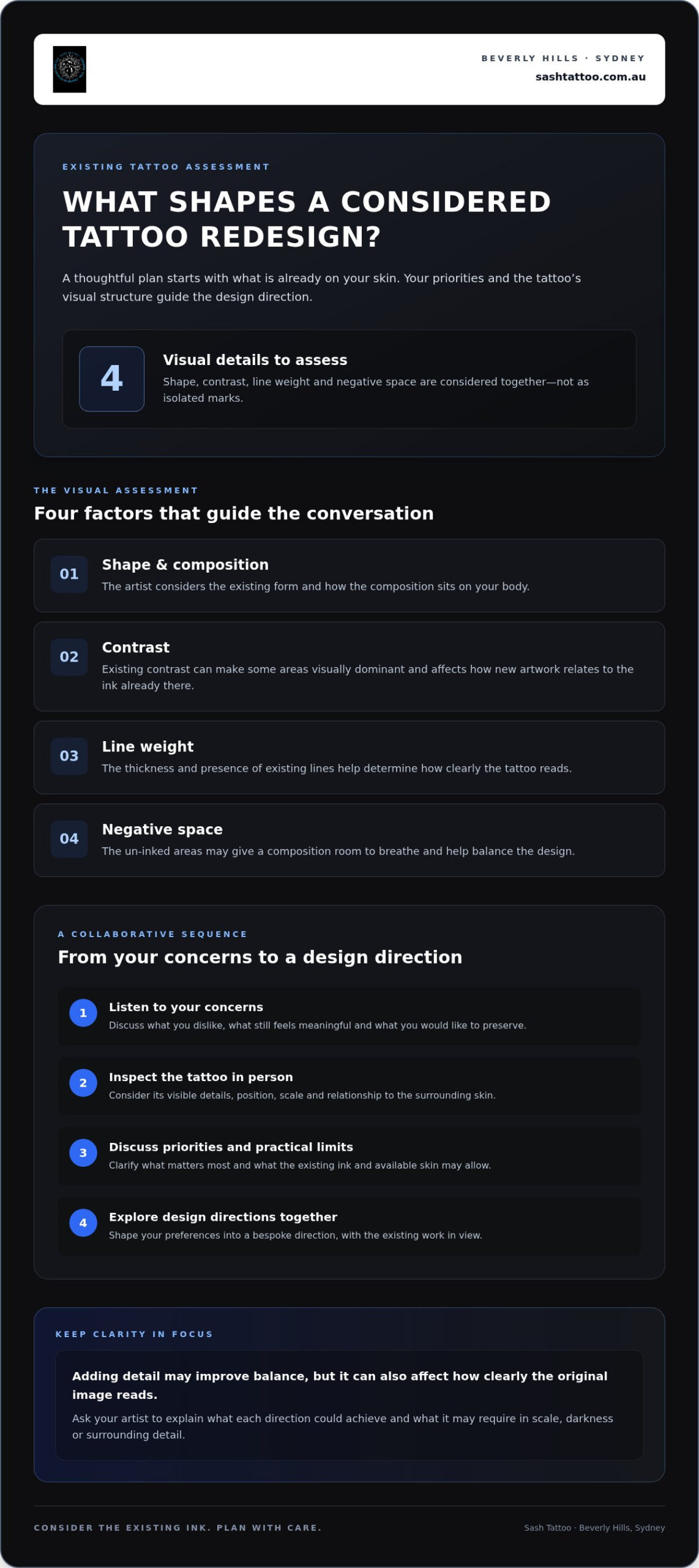
A considered redesign starts with what is already on your skin, not a template. The assessment should follow a clear sequence: the artist listens to your concerns, inspects the tattoo in person, discusses your priorities and practical limits, then explores design directions with you. This gives your preferences and the tattoo’s visual structure equal weight.
Existing ink and composition guide every redesign decision because new artwork must work with the shapes, contrast and space already on your skin. Your artist should explain likely trade-offs rather than promise a predetermined result. Adding detail, for example, may improve balance but could also affect how clearly the original image reads.
How the consultation turns concerns into a design brief
A useful consultation turns broad dissatisfaction into specific design priorities. Your artist can ask what you dislike most, what still feels meaningful and whether there are elements you want preserved. Reference images can communicate mood, subject or style, but work best as guidance rather than instructions to reproduce another person’s tattoo. Artistic judgement helps shape those preferences into a bespoke direction. You can learn about Sash Trajkovski’s tattoo experience as part of that context.
Which visual details influence a realistic redesign?
Size and placement affect how a design sits with the body and how much surrounding skin is available to extend or balance it. Existing marks, line weight and contrast can make some areas visually dominant, while negative space may give a composition room to breathe. The artist considers these elements together, rather than treating each line or patch of shading in isolation.
For example, if a small image feels crowded, adding more fine detail may not improve its readability. A broader composition might create clearer visual hierarchy, depending on the existing ink and available skin. In realism and black & grey realism tattoos, tonal structure can relate separate elements through planned light, shadow and contrast. An individual assessment helps establish whether that approach suits your tattoo.
As you discuss options, ask your artist to explain what each direction could achieve and what it may require in scale, darkness or surrounding detail. A careful plan accounts for what you want to keep as well as what you hope to change. To discuss your tattoo and priorities, you can begin a booking enquiry with Sash Tattoo.
Rework, Add or Redesign: Ways to Improve a Tattoo
Once you have identified the concern, choose an approach that responds to the tattoo as it exists now. Refining a section, building around it or changing the overall composition can each serve a different brief. None is automatically the right choice. Your artist needs to consider how the existing ink will sit within the proposed design and what matters most to you.
The right approach depends on the tattoo’s visual structure and your priorities. Use this comparison to frame the discussion, not as a diagnosis. An individual assessment is needed before settling on a direction.
| Approach | What it may address | What it depends on | Trade-offs to discuss |
|---|---|---|---|
| Refine existing elements | Uneven emphasis, faded-looking details or parts that need stronger definition. | The original lines, shading, colour and space available within the design. | Additional detail may not resolve a concern with the overall shape or concept. |
| Add complementary imagery | A design that feels isolated or lacks connection with nearby imagery. | A suitable relationship between the new subject, existing scale and placement. | The tattoo may occupy more surrounding skin, and additions can affect readability. |
| Redesign the composition | A broader concern with balance, flow or the image’s overall direction. | How existing ink can be incorporated into a cohesive new arrangement. | The new composition may need to extend beyond the original tattoo’s boundaries. |
When refining or adding to the existing design may suit the brief
Selective shading, adjusted detail or surrounding elements can help a tattoo feel more connected and cohesive. For instance, a small botanical motif might be extended with leaves that follow the body’s contours, if the original scale and subject allow. Additions should relate to the existing work rather than compete with it. More ink is not automatically a solution; extra detail can make an already crowded design harder to read.
When a broader redesign or cover-up needs careful planning
A cover-up is not simply a larger version of the original tattoo placed over the top. The existing ink remains part of the new composition, so the artist plans around its position and visual weight. Balance, contrast and readability all matter: a new focal point needs to work with the old marks rather than leave the overall design feeling dense or disconnected.
Style also shapes the visual direction. Custom realism can use carefully planned tonal transitions to bring different forms together, while other approaches may rely on distinct outlines, pattern or colour. The choice depends on the tattoo and your aims, not a general rule about which style suits every cover-up. Explore how to improve a poorly designed tattoo by comparing these possibilities with your artist, including what each might preserve, change or require before you commit to a composition.
Plan a tattoo improvement in Sydney: from references to aftercare
Planning how to improve a poorly designed tattoo is easier when you approach each decision carefully. A clear brief, purposeful references and considered design review help you and your artist stay aligned, from the first conversation to caring for the finished work.
- Clarify your priorities. Decide what matters most: preserving a meaningful element, improving the balance, changing the focal point or creating a stronger connection with nearby tattoos. Separate essential changes from details you’re open to discussing.
- Collect a small set of references. Choose images that communicate subject, mood, composition or technique. A few relevant examples are more useful than a large collection with conflicting directions.
- Attend a collaborative consultation. Bring your references and explain what you want to retain, alter or avoid. Your artist can discuss how those preferences relate to the existing tattoo and develop a bespoke direction.
- Review the proposed design. Consider how the composition sits on your body, where the eye is drawn and whether the existing ink feels integrated. Ask questions before proceeding if an element or design decision is unclear.
- Follow aftercare guidance. Care for the tattoo as instructed by your artist. Once healed, appropriate UV protection can help protect the appearance of the pigments over time.
How to prepare useful references and feedback
Choose references with a purpose. One might show the subject you’re drawn to, while another communicates the mood, flow or shading you prefer. Explain what catches your eye rather than asking for a direct copy. During the design discussion, give specific feedback about the focal point, the scale you have in mind and any existing details you want preserved. This helps your artist interpret your vision while creating original work suited to your tattoo.
What to expect from design review and healing
A digital mock-up can help you discuss how a proposed composition may sit over the existing tattoo and relate to its placement. Treat it as a planning aid, not a guarantee of the final appearance on your skin. Use the review to ask about balance, scale and anything you’re unsure about before tattooing proceeds.
Healing takes time, and a fresh tattoo’s appearance can differ from its settled result. Follow your artist’s aftercare instructions rather than making changes based on its early appearance alone. If you have health concerns during healing, seek appropriate medical advice.
For a considered starting point in Sydney, bring your priorities and references to a collaborative discussion at Sash Tattoo. You can discuss your tattoo redesign and the direction you have in mind.
Improve a poorly designed tattoo with a considered consultation at Sash Tattoo
Choosing what to do with an existing tattoo is personal. At Sash Tattoo’s studio in Beverly Hills, Sydney, a consultation gives you the opportunity to explain what no longer feels right and discuss a bespoke design direction based on the tattoo itself. The aim is to consider what may be possible, not to promise an outcome before the existing work has been assessed.
Why an experienced, collaborative approach matters
Sash Trajkovski brings more than 33 years of tattoo experience to custom work. A redesign asks an artist to respond to existing shapes, marks and tones while keeping your goals in view. Listening closely helps turn concerns such as an unclear focal point or a design that no longer reflects your taste into specific priorities for discussion.
Style should serve those priorities. Realism may be relevant when you want lifelike detail or tonal depth; black and grey work may suit a direction built around contrast and shading. Neither is a universal solution. The existing tattoo, its placement and your preferred visual language all inform the conversation, so the proposed direction can be tailored rather than selected from a formula.
Sash Tattoo’s studio is licensed under the Tattoo Industry Regulation 2023 and has a licensed practitioner. These studio standards sit alongside the artistic discussion, which focuses on your design goals, the existing ink and the trade-offs involved in changing it.
How to take the next step with your existing tattoo
To make the discussion more useful, bring clear images of the tattoo and any original reference you still have. A concise list can help organise your thoughts: what you want changed, what you’d like to preserve and what you want to avoid. A few references can also communicate the mood, subject or style you’re drawn to without asking the artist to copy another design.
The consultation is a chance to explore options together. Discuss how a proposed change may affect the tattoo’s scale, contrast, surrounding skin and readability, and ask about the compromises each direction could involve. The conversation may point towards refining selected details or developing a broader composition. The suitable approach depends on an individual assessment.
Understanding how to improve a poorly designed tattoo starts with an open conversation about what you want your ink to express now. You don’t need to arrive with every design decision settled. Bring your priorities, listen to the artist’s assessment and take time to consider the proposed direction before moving ahead.
If you’re ready to discuss your existing tattoo and possible design directions, Discuss your tattoo redesign with Sash Tattoo.
Give your next tattoo decision thoughtful direction
You don’t need to settle on a redesign before speaking with an artist. A useful next step is to turn your first reaction into a clear intention: what should the tattoo communicate, and what would help it feel more considered on your skin? That perspective can guide a conversation without locking you into a single solution.
Understanding how to improve a poorly designed tattoo means making choices that respect both your preferences and the existing artwork. Bring your questions, be open to discussing trade-offs, and let the design process develop through collaboration. A carefully planned change can offer a more personal direction while keeping clarity and composition in view.
To explore possibilities for your existing ink, book a tattoo consultation with Sash Tattoo in Beverly Hills, Sydney. Clients visit the studio from across Sydney, including Liverpool, Bankstown, Hurstville, Penrith, Parramatta, Camden, Campbelltown, Sutherland, Wollongong, Rockdale, Kogarah, Peakhurst, Mortdale, Roselands, Greenacre, Lakemba, Ramsgate and Earlwood.
Frequently Asked Questions
Can a poorly designed tattoo be improved without changing its original meaning?
Yes, an artist may be able to retain symbols or details that carry meaning while adjusting other parts of the design. For example, a significant date or motif might remain the focal point while surrounding elements are reshaped to better suit the area. Explain what each meaningful feature represents to you. That context helps guide how to improve a poorly designed tattoo without treating personal significance as a purely visual detail.
How do I know whether my tattoo needs a rework or a cover-up?
A rework may suit you if you still value the main image but want particular features refined or extended. A cover-up involves planning a new composition around the existing ink, with its visibility and visual weight considered from the outset. If you’re unsure, consider whether you want the original subject to remain recognisable. An artist can assess the tattoo and discuss the practical differences before you decide.
Can a tattoo artist fix uneven lines or shading?
An artist may be able to refine some uneven lines or shading, but the options depend on the tattoo’s existing marks, scale and contrast. A line that looks inconsistent may need to be incorporated into a wider design rather than simply traced over. Shading can also affect how clearly nearby details read. During an assessment, ask which areas could be adjusted and what changes might alter the overall style.
What should I bring to a tattoo redesign consultation?
Bring clear images of the tattoo, any original design reference you still have, and a few examples that communicate the direction you like. A short written note can help: list the feature you most want changed, the detail you hope to retain and anything you want to avoid. If you know when the tattoo was done or what changes it has had, share that history to give your artist useful context.
Can a tattoo be redesigned in a different style?
It may be possible to take a tattoo in a different stylistic direction, but the existing ink influences the design choices. A fine-lined image, for instance, may need a different balance of detail and contrast if you’re considering a more graphic look. Your artist will assess how the original subject and marks can sit within the new style. Bring references that express the qualities you like, rather than asking for an exact copy.
How long does it take for a redesigned tattoo to look settled?
There isn’t one timeline that applies to every tattoo. Healing and the appearance of the finished work vary, so follow your artist’s aftercare instructions and ask when it makes sense to assess the result. Avoid judging fine details while the skin is still healing. If you have a health concern during recovery, seek appropriate medical advice rather than relying on appearance alone to assess it.
Is it worth improving a tattoo that I no longer like?
It can be worthwhile if changing the tattoo would help you feel more comfortable with the image or its place on your body. You don’t have to decide immediately. Consider what you dislike, whether any part still matters to you and what you hope a new design will express. A consultation can help you weigh those priorities against the visual possibilities, so your choice is considered rather than driven by a passing frustration.
How do I choose an artist for a tattoo redesign in Sydney?
Look for artistic work that relates to the result you have in mind, and pay attention to composition, tonal control and how details sit together. A redesign calls for a considered response to existing ink, not just skill in creating a new image. At Sash Tattoo in Sydney, you can discuss your goals, explore relevant custom styles and talk through design considerations as part of a collaborative consultation.