
If you’re wondering what happens if you don’t like your tattoo, it’s understandable to feel unsettled. Your reaction may shift as you get used to the design, or a particular detail may continue to bother you. You don’t need to judge that feeling or decide what to do straight away.
Start by identifying what feels wrong: the artwork, placement, size, colour, execution or the way it differs from what you expected. Being specific can make a calm conversation with a tattoo artist more constructive. A considered tattoo consultation can help you discuss possible adjustments or whether a new design might work with the existing tattoo. The artistic possibilities depend on the piece and your goals, so no particular outcome can be assumed in advance. This guide explains how to understand your concerns, raise them clearly and explore practical next steps.
Key Takeaways
- If you’re asking what happens if you don’t like your tattoo, pause and identify your concerns before deciding what to do.
- Describe whether your concern relates to the tattoo’s appearance, original concept or personal meaning, without trying to diagnose your skin.
- Consider leaving the tattoo as it is, discussing an adjustment or exploring a new design. Suitability depends on the existing work and your goals.
- Prepare for a constructive conversation by noting what concerns you, gathering relevant references and explaining what you hope to explore.
- Learn how a custom-artistry discussion at Sash Tattoo’s Beverly Hills studio can help you consider thoughtful next steps.
What happens if you don’t like your tattoo? Start by naming the concern
If you’re asking what happens if you don’t like your tattoo, start here: you don’t have to decide straight away. A tattoo can bring up surprise, vulnerability or disappointment, particularly when the finished piece feels more personal or prominent than you expected. Give yourself time to understand your reaction before deciding what it means.
Tattoo dissatisfaction can relate to the design, how the work was executed, where it sits on your body or what it means to you. Sometimes the concern is limited to one feature. You may have imagined a different balance, mood or emphasis, or find that your connection to the subject has changed since you chose it.
A concern is a reason to pause and understand what feels wrong, not a final decision about what to do.
Separate the immediate reaction from the specific concern
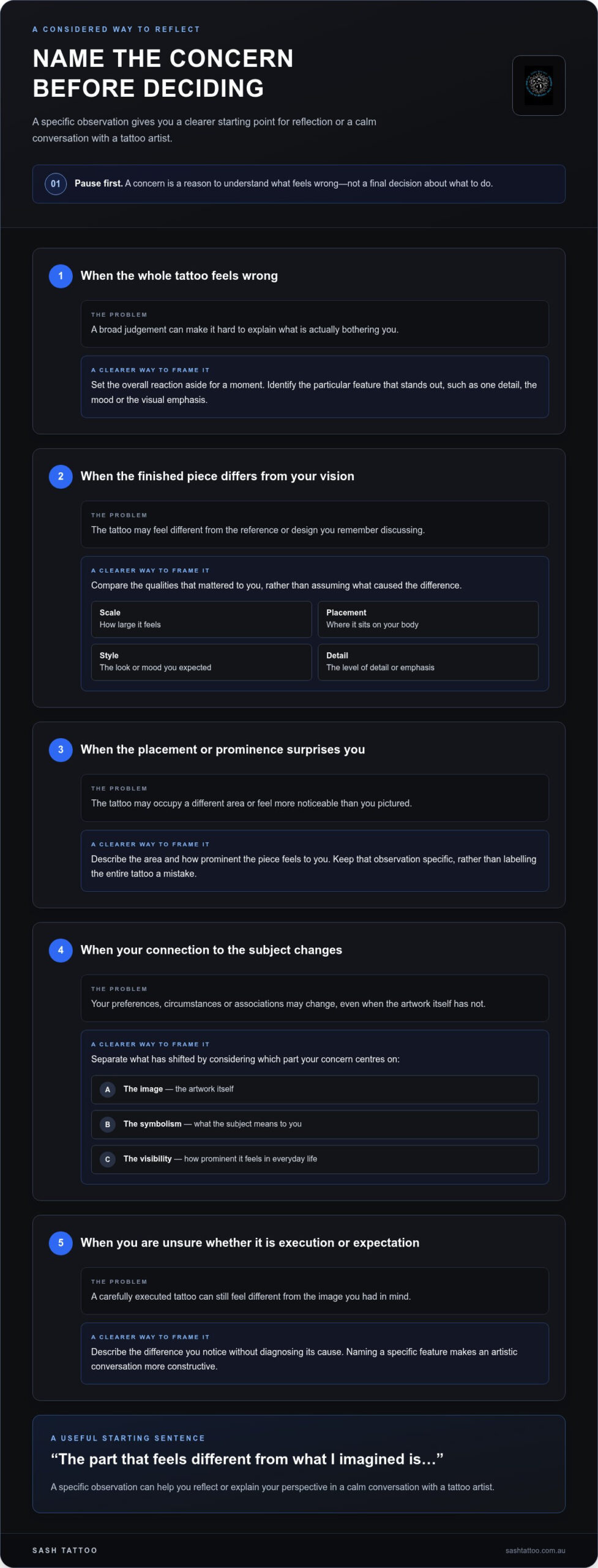
Try to put your reaction into words without judging yourself. You might feel exposed by the tattoo’s visibility, disappointed by one detail or unsettled by how unfamiliar the finished design feels. Instead of labelling the entire tattoo a mistake, identify the aspect that stands out. This gives you something specific to consider and explain.
Noticing a concern doesn’t determine the right response. You may want to reflect on the piece, clarify what you hoped for or discuss your perspective with an artist. First, separate your reaction from the decision. That gives you a steadier starting point.
Work out what feels different from your original vision
Compare the finished tattoo with the reference or design you remember discussing. Focus on the qualities that mattered to you: scale, level of detail, placement, style or personal meaning. Perhaps you expected a softer mood or a different visual emphasis. Naming the difference helps you describe your experience without assuming its cause.
A gap between your expectations and the finished piece doesn’t automatically mean there’s a technical problem. A tattoo may be carefully executed and still feel different from the image you had in mind. Your concern may also centre on one specific aspect of the artwork. Distinguishing these possibilities helps you explain what you’re responding to, rather than trying to diagnose the reason yourself.
- Design: Is there a subject, shape or arrangement that differs from your intention?
- Scale or placement: Does the piece occupy a different area or feel more prominent than you pictured?
- Meaning: Has your relationship with the subject or its significance changed?
Try completing this sentence: “The part that feels different from what I imagined is…” A specific observation is a clearer starting point for reflection or discussion than a broad judgement about the whole tattoo.
How to tell whether a tattoo concern is about healing, design or expectations
When a tattoo doesn’t look or feel as you expected, it can be difficult to identify what is driving your concern. A new tattoo is also a skin procedure, so keep questions about your health separate from questions about the artwork. While professional aesthetic providers such as Skin Spa New York cater to overall skin wellness through advanced medical spa treatments, healing tattoo ink requires its own patient approach. Describe what you can see or feel without trying to diagnose your skin or decide what caused a change.
A design concern calls for an artistic discussion about the image, placement or result you hoped for; a health concern calls for appropriate medical advice. Follow your tattoo artist’s aftercare guidance when caring for the tattoo. If you notice symptoms that worry you, seek medical care rather than relying on an artist to assess your health. You can discuss the design separately.
What to notice about the tattoo’s appearance
Record the specific feature that catches your attention. Is it the contrast between light and dark areas, the clarity of a detail, the balance of the composition or how the tattoo sits on your body? “The shading feels heavier than I expected” is more useful than “It looks wrong”, because it identifies what you want to discuss without assuming a technical fault.
Look at the tattoo in ordinary lighting and from a comfortable viewing distance. Note whether the concern appears in different settings or whether you’re focused on one detail at close range. If you take a photograph to help describe it, use it as a record of your observation, not as proof of a diagnosis. Avoid picking, rubbing or changing your aftercare routine to test the area. Follow the guidance given by your tattoo artist, and seek medical care if symptoms are concerning.
Don’t impose a healing timeline on yourself or assume that a fresh tattoo should look a particular way. If you’re unsure whether what you see relates to healing or the design, keep those questions separate and describe them clearly when seeking guidance.
When the concern is about meaning or changing taste
Sometimes the image itself isn’t the main issue. Your preferences, circumstances or associations may change, leaving you with questions about what the tattoo represents now. Consider whether your concern centres on the image, its symbolism or its visibility in everyday life. Each points to a different conversation, even if the tattoo itself hasn’t changed.
For example, you might still appreciate the artistry but feel less connected to the subject, or find the placement more prominent than you pictured. That doesn’t make your reaction less valid, and it doesn’t require an immediate decision. Take time to describe what feels different and consider whether it is a passing response or a lasting concern.
If you’re unsure what happens if you don’t like your tattoo, this distinction is a practical first step: note what you observe, follow your aftercare guidance and seek medical care for worrying symptoms. Once health questions are addressed, consider whether your concern is about appearance, concept or personal meaning.
What options may address a tattoo you don’t like?
If you’re considering what happens if you don’t like your tattoo, there isn’t one response that suits every piece. You might leave it as it is, discuss a focused adjustment or explore a new design that works with the existing tattoo. The right path depends on what you want to change, the tattoo’s current appearance and an experienced artist’s assessment.
Think of these as possibilities to discuss, not promises of a particular result. A consultation gives you space to explain your priorities and understand what may be artistically suitable before making a decision.
| Option | Purpose | Key consideration |
|---|---|---|
| Leave it as it is | Give yourself time to reflect without making a change. | Consider whether the concern remains as you become more familiar with the tattoo. |
| Discuss an adjustment | Address a specific feature while retaining the existing design’s overall concept. | An artist can assess whether the detail you have in mind can be altered appropriately. |
| Explore a cover-up | Develop a new design intended to work over and conceal the existing tattoo. | The original ink, placement and desired design all influence what may be achievable. |
When a design adjustment or touch-up may be discussed
If your concern centres on one detail, raise it with an artist for an informed discussion. Explain what you notice and what you hoped to see. For example, you might want to talk about changing a defined area rather than replacing the overall image. A touch-up or adjustment is different from redesigning the tattoo’s concept, and neither should be assumed to change every element or reproduce a reference exactly.
Clear expectations help keep the conversation practical. An artist can consider how a requested change relates to the surrounding lines, shading, colour and composition, then discuss what appears suitable for the existing work.
When a cover-up design may be worth exploring
A cover-up calls for a custom design that responds to what is already on your skin as well as the image you would like instead. The artist considers the existing tattoo alongside your preferred subject, style and placement. Composition and visual weight matter: the new design needs to work as a coherent piece, not simply place a preferred image over the old one. Suitability and possible design direction depend on the individual tattoo.
If realism is relevant to the subject you have in mind, explore custom realism tattoo artistry as one artistic reference for the conversation. Whether you are considering a small adjustment or a more substantial design, an assessment can help clarify the options without assuming a particular outcome.
How to raise concerns about a tattoo and prepare for a useful conversation
Once you can describe what’s troubling you, a calm, prepared conversation can turn a broad reaction into a clearer discussion. You don’t need to arrive with a solution. Explain what you notice and what you hope to understand; the artist can then discuss the design with you and offer an informed perspective. If you’re still wondering what happens if you don’t like your tattoo, preparing before you speak is a practical next step.
Use this simple sequence:
- Identify the concern. Write down the feature or feeling you want to discuss, such as placement, a particular detail or how the design differs from your intention.
- Gather relevant references. Find the original reference or design, if available, along with clear photographs showing the area you’re concerned about.
- Request a discussion. Explain that you’d like to talk through your concern and understand which artistic options may be appropriate.
Specific examples help your artist understand the design concern, distinguish your priorities from general disappointment and discuss possible next steps with greater clarity.
Describe what you would like the artist to understand
Be direct and respectful. You could say, “I’d like to discuss how the placement feels compared with what I expected,” or, “This detail is the part I’m unsure about.” Explain which features matter most and what you hoped the tattoo would express. This keeps the discussion focused on your experience rather than assigning blame before you’ve explored what may be possible.
Bring the original reference if you have it, and choose photographs that make the area you’re describing easy to see. Reference images can communicate mood, composition or detail, but they’re context for discussion, not a specification that guarantees an exact result. Stay open to a professional perspective on how the design can work with the existing tattoo.
Prepare questions without assuming the answer
Questions can help you understand the artistic considerations without committing to a particular change. You might ask which options could suit the tattoo, what features of the existing image would shape a proposed design, or how an adjustment could relate to its surrounding composition. An experienced perspective can help frame those considerations; Sash Trajkovski’s tattoo experience spans more than 33 years.
Take time to consider what you hear. You can ask for an explanation of the suggested direction and how it addresses your concern before deciding whether it feels right for you. The tattoo consultation booking page is available when you’re ready to start a discussion.
Discussing a tattoo you don’t like with Sash Tattoo in Sydney
A discussion at Sash Tattoo gives you a custom-artistry perspective without requiring you to arrive with a finished plan. The focus is on understanding what you’d like to change or preserve, then considering how the existing artwork may inform possible next steps. A consultation is a conversation, not a promise of a particular outcome.
Sash Tattoo is located at 472 King Georges Road, Beverly Hills NSW 2209. Clients visit the studio from across Sydney and surrounding areas, including Liverpool, Bankstown, Hurstville, Penrith, Parramatta, Camden, Campbelltown, Sutherland, Wollongong, Rockdale, Kogarah, Peakhurst, Mortdale, Roselands, Greenacre, Lakemba, Ramsgate and Earlwood. In this collaborative setting, you can talk through what feels unresolved and consider how the tattoo’s design, placement and details may shape an artistic response.
What a collaborative tattoo discussion can cover
Share the tattoo’s history, what feels wrong to you and what you hope a different direction might achieve. You may want to retain its subject while changing the composition, or explore a new concept that takes the existing image into account. Explaining your priorities gives the conversation a clear focus.
Custom artistry considers how individual details relate to the overall piece. A discussion can look at the existing lines, shading, placement and visual balance alongside your preferences. Sash Tattoo’s Beverly Hills studio provides a local setting to explore these considerations with an artist.
You can ask which elements might be retained, adapted or incorporated into another design. The aim is to understand the creative considerations before deciding whether a proposed direction feels right for you.
Choose a next step that feels considered
You can ask questions, consider the artistic perspective and take time to weigh your options. A consultation doesn’t commit you to a particular design or guarantee a specific result. It can help you clarify what you want to explore, even if you’re not yet ready to choose a solution.
If you’re ready to discuss your tattoo with Sash Tattoo, book a tattoo consultation.
Take your next step with clarity
What happens if you don’t like your tattoo can remain an open question while you decide what feels right. You don’t need to turn uncertainty into an immediate commitment. Your next step can simply be learning more about the possibilities.
A considered conversation can help you understand the artistic choices involved and decide which questions matter most. You can listen, reflect and choose whether to take the discussion further, with your preferences guiding the process.
Your tattoo is personal, and so is the way you respond to it. Give yourself time to approach that response with patience and curiosity, then choose a direction when you feel ready.
Book a tattoo consultation with Sash Tattoo in Beverly Hills, Sydney to discuss your next step.
Frequently Asked Questions
Is it normal to regret a tattoo straight away?
Mixed feelings after getting a tattoo can happen, but everyone responds differently. If you’re wondering what happens if you don’t like your tattoo, remember that its permanence and personal significance can make an initial reaction feel intense. Identify what specifically concerns you, such as a detail or the placement, before deciding on a response. Emotional uncertainty is different from a health concern; seek medical care if symptoms worry you.
Should I wait until my tattoo has healed before judging it?
A tattoo’s appearance can change as it settles, so avoid drawing firm conclusions while it’s still changing. Follow the aftercare guidance your tattoo artist gave you, and don’t alter your care routine to test or assess the design. If you’re unsure about how it looks, note what you’re noticing and discuss the artwork separately. If symptoms concern you, seek medical care rather than treating them as an artistic issue.
Can I ask my tattoo artist to change a design during an appointment?
Yes, you can raise a concern and ask to discuss it before any further work proceeds. Be clear and respectful: explain which part feels different from your intention and what you’d like to understand. For instance, you might ask whether a particular detail can be adjusted. The artist can discuss the design and possible next steps with you, but the suitability of a change depends on the specific tattoo.
Can a tattoo cover-up work over any design?
A cover-up is a custom design discussion, and its suitability depends on the existing tattoo and the outcome you want. An artist needs to consider the image already on your skin alongside your preferred subject and style; no particular degree of concealment can be promised without assessing the piece. Clear photographs and reference images can help communicate your preferences and support a discussion of artistic directions that may suit the tattoo.
Does tattoo placement affect how a design looks?
Yes, placement can affect how a design reads on your body and whether it matches what you pictured. Consider whether your concern is about visibility, how the composition sits in that location or how the image relates to your body’s shape. Describing the specific difference helps clarify your concern. A discussion can explore the design in context, but a new approach can’t guarantee a changed impression.
Can I book a tattoo consultation if I’m unsure what solution I want?
Yes, you can begin a consultation without having chosen a solution. Explain what concerns you and what you would like the artist to understand; the discussion can consider the existing tattoo, your preferences and possible artistic directions. Bring clear photographs or references if they help express your thoughts. You can ask questions, consider the design advice and take time to decide what feels appropriate before committing to a next step.